

Nutritional Counseling
Pet Nutritional Counseling in Edgewater, NJ
Nutrition affects nearly everything we treat, such as weight, joints, skin, digestion, kidney and heart health, and how comfortably a pet ages. It is also the one area of your pet's care you manage yourself, every single day. That makes it worth a real conversation.
Why Nutrition Is Worth a Conversation
Survey after survey places more than half of American dogs and cats in the overweight or obese range. It is the most common nutritional problem in companion animals, and it is consequential. Excess weight shortens lifespan and worsens arthritis, diabetes, and heart and respiratory disease.
It is also genuinely hard to see at home. Weight goes on slowly. You see your pet every day, and an extra two pounds on a twenty-pound dog is a ten percent gain that looks like nothing. This is one of the main reasons we weigh and body-condition score at every visit. The trend over time tells us far more than any single number.
If your pet's weight has been drifting, we will tell you, and we will give you a realistic plan rather than a lecture.
Feeding by Life Stage
Nutritional needs change substantially over a pet's life, and life stage is the most important factor in choosing a food.
Puppies and kittens need calorie-dense, growth-formulated diets and more frequent meals. A twelve-week-old puppy typically eats three times a day, reducing as they approach six months. Large-breed puppies have their own considerations, since growing too quickly can affect joint development.
Adults need maintenance nutrition matched to their actual activity level. A dog who walks the waterfront twice a day and a cat who naps in a window have very different requirements, and the same bag of food will not serve both.
Senior pets often benefit from adjustments for kidney function, joint support, muscle maintenance, or calorie reduction as activity declines. This is also when many pets develop conditions where diet becomes part of the treatment.
Transitions between stages are worth discussing rather than guessing at, particularly the move from growth to adult food.
How Much, and How Often
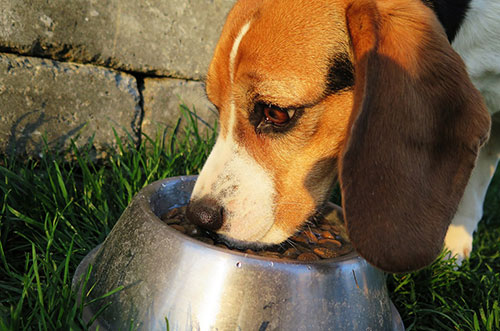
Scheduled meals are what we generally recommend. Measured portions at set times let you control intake precisely, make it straightforward to give medication with food, and support any calorie-controlled plan. Most pets settle into the routine quickly.
There is a less obvious benefit that matters more than people expect. When your pet eats at set times, you know immediately if they skip a meal, and a change in appetite is one of the earliest signs of illness in both dogs and cats. That signal is worth a lot.
Free-feeding, leaving food available at all times, is undeniably convenient and only workable with dry food. But it carries real trade-offs. It is associated with overeating and weight gain, and it makes portion control essentially impossible. If the bowl is always full, you may not notice for days that your pet has stopped eating.
When Diet Is Part of the Treatment
For a number of conditions, food is not a supporting player. It is the treatment.
Therapeutic diets are formulated to manage specific medical problems, and they are prescribed the way a medication is prescribed for a diagnosis, at a specific formulation, with monitoring. Special foods are particularly important to treat conditions such as constipation, kidney disease, liver disease, pancreatitis, allergic skin conditions, inflammatory bowel disease, diabetes and obesity.
Weight Management
If your pet needs to lose weight, we will work out a plan with specific numbers rather than telling you to feed less.
That generally means a target weight, a measured daily calorie amount, guidance on treats (which are a larger share of the problem than most owners realize), and recheck weigh-ins to confirm the plan is working. Safe weight loss is gradual, and cats in particular must lose weight slowly, since rapid loss can cause serious liver complications.
Serving Edgewater and the Surrounding Communities
We provide nutritional guidance for dogs and cats throughout Edgewater, Cliffside Park, Fort Lee, North Bergen, West New York, Weehawken, Union City, Fairview, and the surrounding Bergen and Hudson County waterfront, and New York.
We are located at 890 River Road in Edgewater, with parking on site.
Frequently Asked Questions
How do I know if my pet is overweight? You should be able to feel your pet's ribs without pressing hard, and see a visible waist when looking down from above. If neither is true, bring them in. We will body-condition score them and give you a straight answer.
Is the food I am buying good enough? Bring the bag or a photo of the label to your next visit. We will look at it with you.
My cat is a grazer. Do I have to switch to scheduled meals? Not necessarily, and cats do naturally prefer small, frequent meals. There are ways to preserve that pattern while still controlling intake, like measuring the day's full portion in the morning, or using puzzle feeders. We can work through the options.
Do you recommend a specific brand? We recommend based on your individual pet rather than defaulting to one brand. What matters most is that the food is complete and balanced, appropriate for your pet's life stage, and made by a manufacturer with real nutritional expertise behind it.
My pet is a picky eater. What should I do? First, we want to rule out a medical cause, since dental pain and nausea both present as pickiness. Once your pet is cleared, it becomes a feeding-routine question, and there is a lot we can do.
Let's Talk About What Your Pet Is Eating
Whether you have a new puppy, a senior pet whose needs have shifted, a weight concern, or just an honest question about the food you are buying, we are glad to help.
Call (201) 941-7880 or request an appointment online to schedule at the Edgewater Animal Hospital.

All Services
Learn More
Keep
In Touch

Our Services
Contact Info
Hours of Operation
- Monday 8:15am - 4:00pm
- Tuesday 8:15am - 5:00pm
- Wednesday 8:15am - 5:00pm
- Thursday 8:15am - 5:00pm
- Friday 8:15am - 4:00pm
- Saturday 8:15am - 1:00pm
- Sunday Closed
© 2026 Edgewater Animal Hospital. All rights Reserved. Accessibility Statement - Privacy Policy - Sitemap
Powered by:
